 |
| Everyones Favourite Subject |
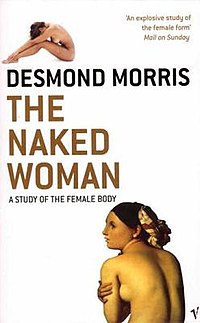
Although I read it as I would any other popular science book, I couldn't help but start to relate the information Morris was providing to my own experiences as a cross-dresser, especially in his observations around the way women present themselves to others. I also started to wonder whether it might be quite useful to identify some of those key elements for further consideration, especially when looking to present in a 'feminine' manner. I never actually got round to doing so when actually reading the book, but the self-indulgence of a blog means I can carry through on the idea and basically extract some insights and information from the text and, who knows, it might actually prove of some help or interest to others as well as myself. One thing it isn't though is a sort of make-up tutorial in disguise, rather it's an exploration as to the reasons certain features are prized - full, red lips, wide eyes, that sort of thing. It might throw some light on what we're trying to achieve and why it works. Possibly...
The book has 22 chapters, each devoted to a single aspect of the female anatomy and my plan is to pick through and highlight any quotes, phrases or ideas that I think might throw some light on the key differences between the sexes and how these might be incorporated into my own attempts at feminisation - and if they can't to at least understand why!
So to get the ball rolling, I'm kicking off with those two sections that are least specific but which help to set the tone and the framework of Morris' more pertinant observations
INTRODUCTION -
One key concept from Morris straight away "The human female has undergone dramatic changes during...evolution - far more than the male" and that evolution means that the human female is far more removed from other primate females than human males are from primate males. Hence her uniqueness.Morris then talks of societies constant desire to 'improve' upon nature and his own anger that relatively recent developments in civilisation (i.e. urbanisation) has led to patriarchal societies where previously it was more equitable. He concludes by saying he will be looking at the biological aspects of each part of a woman's body before going on to look at the various modifications that societies have made to it over the centuries.
OK, nothing too groundbreaking other than making a case for the 'beauty' of the evolved female form. I can't disagree with that...
1. EVOLUTION -
In the opening chapter Morris puts a great deal of our success as a species down to our ability to adapt to stress and to breed in far larger groups (cities as a prime example) than our primate cousins could tolerate. But in order to do so required some major adaptations. Our features of friendliness and curiosity play major roles in allowing us to develop this adaptation but these features are mainly found in the juveniles of other species. In order to succeed it therefore become important for us to retain many juvenile features into adulthood, a process known as neotany.
It seems that neotany is ultimately responsible for many human characteristics, but the two sexes developed them in different ways. In a nutshell "Men are slightly more childlike in their behaviour, women in their anatomy." and to illustrate the point I'll simplify an extended example Morris provides, namely..
The female body, being so important for reproduction, had to be better protected...as a result the curvaceous female body contains 25% fat....the stringy male only 12.5%. This greater retention of puppy fat in the female was a strongly infantile characteristic, and with it went a whole host of other juvenile features that served her well.Morris contends that the human child needs both parents to ensure it's survival and that human males are adapted to be strongly protective of their children. It made sense then for the human female to exploit this by retaining as many of the child's juvenile features as possible to elicit the same response from her mate.
The female voice is higher, like a child's, women keep the child's hair pattern and smooth baby-faces and many other physical child-like features whilst at the same time developing away from the childish mental state. Males on the other hand had fewer physical child-like features (although far more than other primates) but retained far more of the juvenile mental attributes of curiosity, risk-taking etc.
So it seems women are cunningly designed to elicit a similar response from males as we provide to lovely little babies and cute children. Sadly this might explain some of the root of the darker side of human behaviour such as paedophilia and other sex abuse, where the edges become blurred for some and they then flip the sexual attraction back on the juveniles rather than the female. I wonder if there's any documented examples of sexual abuse amongst other primate groups where neotany isn't prevalent?*
Anyway the stage is now set for head-to-toe detailed look at the physical female form starting with the woman's crowning glory, her hair!
 |
| Coming next time... wild hair! |
